
How shall I sing that majesty (Coe Fen) SATB & descant
Wednesday 24 April 2024
home >
Ken Naylor, arr. Alistair Warwick:
How shall I sing that majesty
ISMN
Octavo: 979-0-708195-00-9
PDF: 979-0-708195-01-6
- one of the finest hymn tunes ever written
- "number one" in the Top Five Hymns in Church Times/RSCM survey
- thousands of copies bought by churches and schools throughout the world
Download sample"splendid arrangement … I feel sure many choirs
(and congregations) will enjoy it."Martin Neary
former Organist of Westminster Abbey
Download a free PDF of the words for your congregation
Suitable for:
- Music Sunday
- choral festivals
- Ascension
- Christ the King
- or any celebration of music in worship
Also listed in Sunday by Sunday as suitable for Trinity Sunday.
Difficulty level: *** (moderately difficult)
This piece in four verses is available as a printed choral leaflet or as a digital download (PDF).
It will give your singers a challenge that they will enjoy!
Customers who bought this item also bought
Please sign up to our newsletter if you'd like to be informed about future publications
Some notable performances of this arrangement
- RSCM Scottish Triennial Festival at St Michael's, Linlithgow, Scotland on 4 November 2006
- featured in a choral-reading session with David Briggs, formerly of Gloucester Cathedral, at the 12th Annual East Carolina Religious Arts Festival, USA in 2008
- sung at the RSCM Australia Summer School in January 2011
- subsequently sung by many choirs around the world, including cathedrals and college choirs

Notes on the piece
The wonderful hymn tune Coe Fen was composed by Kenneth Naylor (1931–91), formerly music master at the Leys School, Cambridge.
Your copy includes a choral arrangement and a final-verse descant.
Choral arrangement
This arrangement by Alistair Warwick sets the middle verses as a four-part choral version from the original organ texture. Verse two can be sung without organ if desired.
Between each verse there is a short link by the organ, except after verse two where the heavenly "alleluias" are echoed by an optional semi-chorus:
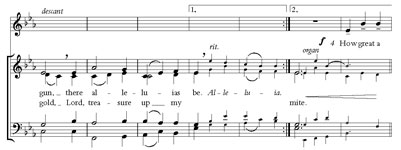
Elements of Naylor's writing are used throughout the arrangement, especially the three-note motive "Eb G F" (the first three notes of the melody and its transpositions).
Descant
Verse four features a sensitively understated descant to suit the text. Although six bars specify a double descant, it works equally well with just the upper line.
Experienced organists will naturally use the organ part in the last verse as a basis for their accompaniment.
Here is the final part of the descant:
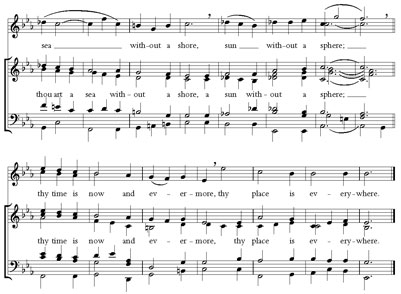
The hymn can, of course, be sung in unison without any choral contributions (the original organ part is included); indeed, the assembly is encouraged to sing the melody throughout.
Although the music is copyright (see "Notes" about the use of this work), the text is in the public domain, so the words can be freely copied for use by your congregation.
About the text (including the author's ordering of the verses)
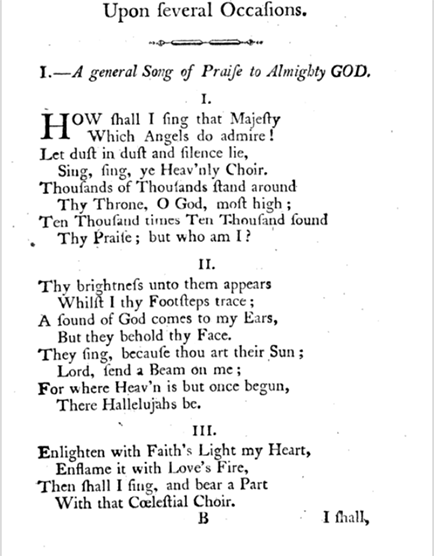
Opening verses from a 1785 printing,
apparently showing the order of the verses Mason intended
This inspiring text by John Mason has taken almost 300 years to be wedded to a worthy tune. (Tallis's Third Mode Melody is a fine tune, but the partnership doesn't quite work!)
The author
John Mason was born c. 1645 in Irchester, Northamptonshire, England and baptised in March 1646.
He was Rector at Water Stratford Church from 1674-1694.
He died in 1694 at Water Stratford, Buckinghamshire, England, where he was buried on 22 May.
The text
The original hymn, with 12 verses (see below) and subtitled 'A General Song of Praise to Almighty God', is based partly upon Psalms 103 (104) and 138 (139).
The text appears as part of the first hymn in Mason's Spiritual songs, or, Songs of Praise to Almighty God upon Several Occasions: together with the Song of Songs which is Solomons.
This collection was published in London in 1683, and printed "for Richard Northcott, at the Marriner and Anchor, adjoyning to St. Peters Alley in Cornhil" with a third edition printed in 1691.
I have not yet found a date for the second edition.
Comparison with 'My song is love unknown'
J.R. Watson's An Annotated Anthology of Hymns (OUP, 2002) [1], with a foreward by Timothy Dudley-Smith, draws comparisons with 'My song is love unknown' by Samuel Crossman, saying that they are both asking the same questions, but in different ways:
My song is love unknown |
How shall I sing? |
What may I say? |
Who am I? |
Important note about the verses
Originally John Mason wrote 12 verses for this hymn.
The first four verses are as we know them, albeit with quaint spelling; the remaining eight have fallen out of fashion, perhaps understandably.
Order of the verses
The verse order is treated in various ways.
While most hymnals have four verses for this hymn, some hymnals have only three.
Those with four verses have differing arrangements of the text in the middle two verses.
According to the 19th-century printing (see below), with all 12 verses, the first four verses are as used in this edition, with modern spelling.
Summary of all versions
- 1, 2, 3, 4: the solution offered here, which seems logical and to represent the author's intentions
(NEH 373 and others) - 1, 3a/2b. 2a/3b, 4: switching the second half of verses two and three
(Common Praise, Sing Praise 280) - 1, 2/3, [4]: conflating verses two and three
- 1, 2, [4] verse two only
(CH4 128)
Hymnary.org has the order as printed in this publication.
See "The text" tab for the complete text.
Choices for music directors
- Print copies of the words (PDF) for your congregation.
- If you only have three verses in your hymnbook, you could ask the congregation to sing the first and last verses, whilst the choir sings the two middle verses.
- If your hymn book has the other order of verses and you want to continue singing it this way, you can mark up your choral copies so that they reflect what is in the hymn book. Copies supplied since 24 August 2020 have arrows marked in the score, indicating where to switch to the other verse:
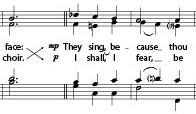
- Print the words (see "The Text" tab) in your service sheet or newsletter. The text is in the public domain and freely copyable.
Footnote
1. See pages 111-13 in Amazon's Book Preview for more background to this hymn text.
Reviews
"splendid arrangement … I feel sure many choirs (and congregations) will enjoy it."
Martin Neary, London, England
"Your edition fits my needs perfectly. Thank you so much for the edition and your prompt service!"
Mary, Pennsylvania, USA
"What a great tenor line!"
Stuart Robinson, Penmaenmawr, Wales
"We premiered your setting of 'How shall I sing...' on Easter Sunday and it went down a storm. The choir love it, especially the altos who are delighted not to have endless strings of one or two notes!"
Claire Corbett, Midlands, England
Buy your copies

We accept credit and debit cards for payment.
Your order will be placed in pounds sterling (GBP); however, your credit card company will bill you in your own currency.
PDF download
To order a printable PDF, decide whether you want
- a licence to print up to 10 copies
- a licence to print up to 30 copies
- a licence to print up to 50 copies
then click on the relevant button below.
Our sales are administered by e-junkie.com and you will be taken to their website to complete the transaction.
When your payment is complete, you will be able to download your PDF.

We treat your privacy seriously: we hate spam, just like you do.
We will not sell or give your details to anyone else, and you can unsubscribe at any time.
Do I need a PayPal account to buy music?
If you have a credit or debit card you don't need a PayPal account.
- Click on the relevant Buy Now button, and you will be taken to PayPal. Look for the following image:

- Click on the "Continue" button (not shown here).
Delivery notes
PDF (Portable Document Format)
Orders for PDFs are normally processed immediately. Your licensed PDF should be available within a few minutes of your payment.
You will need a PDF reader to view the file. The most popular is Adobe Reader, although other suitable programmes are also available.
Printed copies (octavos)
Orders for printed copies (where available) will normally be processed within 48 hours (excluding weekends and holidays).
Please note that in accordance with our environmental policy, we try to use suitable re-used packaging wherever possible.
Privacy policy
Special arrangements for sublicensing & recording
This arrangement of Coe Fen is made under licence from Oxford University Press (OUP) who own the copyright to the original tune Coe Fen, and thus any arrangements of the work.
Sublicensing & recording, broadcasting etc.
You should direct requests for sublicensing to OUP music.enquiry(at)oup.com (this includes inclusion in any other publication, recording, broadcasting, or public performance outside worship).
Please send a copy of your request to copyright(at)theartofmusic.com.
Please make clear in any negotiations with OUP that it is this arrangement that you wish to use, quoting "Naylor, arr. Warwick: Coe Fen, published 2006, The Art of Music".
This will ensure that we receive the appropriate royalties from further use of this work.
The text
See "About the text" for an explanation of the verses.
Modern spelling (as it appears in modern hymnals)
1 How shall I sing that majesty
which angels do admire?
Let dust in dust and silence lie;
sing, sing, ye heavenly choir.
Thousands of thousands stand around
thy throne, O God most high;
ten thousand times ten thousand sound
thy praise; but who am I?
2 Thy brightness unto them appears,
while I thy footsteps trace;
a sound of God comes to my ears,
but they behold thy face:
They sing, because thou art their sun;
Lord, send a beam on me;
for where heaven is but once begun,
there alleluias be.
3 Enlighten with faith's light my heart,
inflame it with love's fire,
then shall I sing and take my part
with that celestial choir.
I shall, I fear, be dark and cold,
with all my fire and light;
Yet when thou dost accept their gold,
Lord, treasure up my mite.
4 How great a being, Lord, is thine,
which doth all beings keep!
Thy knowledge is the only line
to sound so vast a deep:
thou art a sea without a shore,
a sun without a sphere;
thy time is now and evermore,
thy place is everywhere.
John Mason (1646–1694)
A note on the text
See "About the text" for an explanation of the verses.
NEW: Print copies of the words (PDF) for your congregation.
Alternatively, if you only have three verses in your hymnbook, you could ask the congregation to sing the first and last verses, whilst the choir sings two verses in the middle.
Since the text is in the public domain, you could also print the words in your service sheet or newsletter.
John Mason's original spelling
1 How shall I Sing that Majesty
Which Angels do Admire?
Let Dust in Dust and Silence lie,
Sing, Sing, ye Heavenly Quire.
Thousands of Thousands stand around
Thy Throne, O God, most High;
Ten Thousand times Ten Thousand sound
Thy Praise; but who am I?
2 Thy Brightness unto them appears,
Whilst I thy Footsteps trace;
A Sound of God comes to my Ears;
But they behold thy Face.
They Sing because thou art their Sun,
Lord, send a Beam on me;
For where Heav'n is but once begun,
There Hallelujahs be.
3 Enlighten with Faith's Light my Heart,
Inflame it with Love's Fire;
Then shall I sing and bear a part
With that Celestial Quire.
I shall, I fear, be dark and cold,
With all my Fire and Light:
Yet when thou dost accept their Gold,
Lord, Treasure up my Mite.
4 How great a Being, Lord, is thine,
Which doth all Beings keep!
Thy Knowledge is the only Line
To sound so vast a Deep.
Thou art a Sea without a Shore,
A Sun without a Sphere;
Thy Time is now and evermore;
Thy Place is everywhere.
5 How good art thou, whose Goodness is
Our Parent, Nurse, and Guide;
Whose Streams do water Paradise,
And all the Earth beside!
Thine Upper and Thy Nether Springs
Make both thy Worlds to thrive:
Under thy warm and sheltering Wings
Thou keep'st two Broods alive.
6 Thy Arm of Might, most mighty King,
Both Rocks and Hearts doth break:
My God, thou canst do every thing
But what would shew thee Weak.
Thou canst not cross thy self, or be
Less than thy self, or poor;
But whatsoever pleaseth Thee,
That canst thou do, and more.
7 Who would not fear thy Searching Eye,
Witness to all that's true?
Dark Hell and deep Hypocrisy
Lie plain before its view.
Motions and Thoughts before they grow,
Thy Knowledge doth espy;
What unborn Ages are to do,
Is done before thine Eye.
8 Thy Wisdom, which both makes and mends,
We ever much admire:
Creation all our Wit transcends;
Redemption rises higher.
Thy Wisdom guides stray'd Sinners home,
'Twill make the dead World rise,
And bring those Prisoners to their Doom,
Its Paths are Mysteries.
9 Great is thy Truth, and shall prevail
To Unbelievers shame;
Thy Truth and Years do never fail;
Thou ever art the same.
Unbelief is a Raging Wave,
Dashing against a Rock:
If God doth not his Israel Save,
Then let Egyptians mock.
10 Most Pure and Holy are thine Eyes,
Most Holy is thy Name;
Thy Saints, and Laws, and Penalties,
Thy Holiness proclaim.
This is the Devil's Scourge and Sting,
This is the Angels Song,
Who Holy, Holy, Holy, Sing,
In Heavenly Canaan's Tongue.
11 Mercy, that shining Attribute,
The Sinner's Hope and Plea!
Huge Hosts of Sins in their Pursuit,
Are drown'd in thy Red Sea:
Mercy is God's Memorial,
And in all Ages prais'd;
My God, thine only Son did fall,
That Mercy might be rais'd.
12 Thy bright Back-parts, O God of Grace,
I Humbly here Adore;
Shew me thy Glory and Thy Face,
That I may praise Thee more.
Since none can see thy Face and live,
For me to die is best;
Thro' Jordan's Streams who would not dive,
To Land at Canaan's Rest?
John Mason (1646–1694)
Spiritual Songs
Spiritual Songs,/or/
Songs of Praise/to/Almighty God,/Upon Several Occasions,/
by the/Rev. John Mason, M.A.,/Rector of Water-Stratford, Buckingham,
(London, D. Sedgwick, Hamilton, Adams, and Company, 1859)
Buy from Amazon